
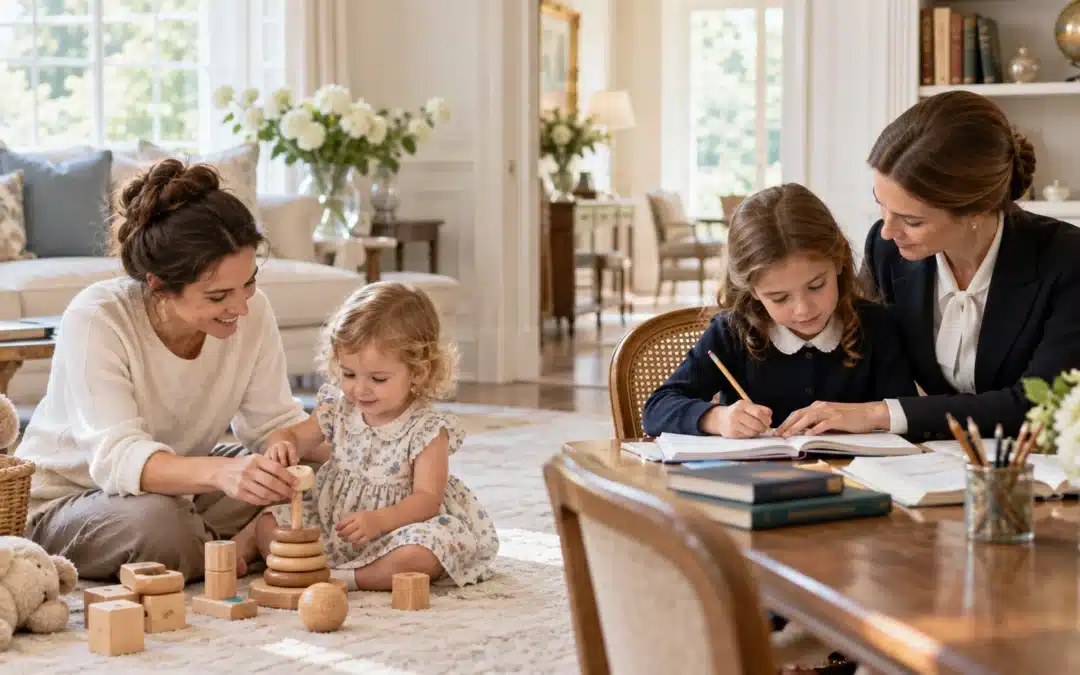
Families often use “nanny” and “governess” as if they mean the same thing. In practice, they are different roles. Both care about children, and both support their learning. What differs is how they do it, which ages they suit best, and how the day is shaped.
This guide looks at the differences by your children’s ages and needs, and by your family’s lifestyle. It’s a general overview, and every family is different, so there’s no one-size-fits-all answer.
Key points:
- Both nannies and governesses support learning. A nanny typically does it through play, routine, reading and age-appropriate activities, as part of everyday care. A governess typically works towards set goals, such as a curriculum, a language, exam or school-entry preparation, or cultural enrichment.
- Age is often the clearest guide. Nannies work with children from birth upwards. Governesses generally work with children of school age, from around the start of formal schooling. The school system your children follow (British, American, International Baccalaureate or Spanish) matters too.
- Backgrounds usually differ. Nannies typically bring childcare studies and/or hands-on experience. Some come from social studies or other degree backgrounds, and built their childcare experience alongside or afterwards. Governesses often bring teaching qualifications and/or substantial teaching experience in a particular curriculum or subject. Some also hold language degrees, or backgrounds in social sciences or etiquette.
- A governess does not typically take on practical childcare tasks such as children’s laundry or meal preparation, and it is rare for the role to include them. Her time is generally given to teaching and learning. If a family wants both in one role, that points towards a nanny-governess, and it’s best to agree the scope in writing from the start.
- For many families, there may be a need for a blend of both. The right choice generally depends on your children’s ages, schooling, travel, languages and daily routine.
The short answer: two ways of supporting learning
A nanny looks after the whole child. Her day is built around routines, meals, naps, play, outings, school runs and emotional support. Learning is part of all of this. It happens through play, stories, conversation, homework help and activities that suit the child’s age and stage of development. Many nannies are very intentional about this. The difference is that the learning follows the child’s age and pace, rather than a set plan.
A governess is an educator who works within the family home. Her day is generally organised around goals: following or supporting a curriculum, building a specific language, preparing for exams or school entry, developing study habits, and cultural enrichment. She still cares about the children’s wellbeing. But learning goals and progress tend to shape how her day is planned.
So the real difference isn’t “care versus education.” It’s learning that happens as part of everyday care, versus learning that sets the plan for the day, with care around it.
Where the governess role comes from
The word “governess” has old associations, particularly with nineteenth-century British households, where a governess taught the children of wealthy families at home. For many people it still suggests formality.
The modern governess is rather different. She is usually a professional educator, often with teaching qualifications, who supports learning in a way that fits family life. Today’s families tend to look for one because of frequent travel, moving between countries, children changing school systems, bilingual or trilingual upbringing, or a wish for more individual academic attention than a busy classroom can give.
In Spanish, the roles are usually called institutriz (governess) and niñera (nanny). Both terms are used by international families across Spain, sometimes interchangeably, which is one reason it helps to define the role clearly before you start recruiting.
Nanny vs governess: the key differences
|
Nanny |
Governess |
|
|
Approach to learning |
Play-led and routine-based; age- and development-appropriate |
Goal-led and structured; curriculum, languages, exams, cultural enrichment |
|
Typical ages |
From birth upwards |
Generally school age, from around the start of formal schooling, sometimes into the teens |
|
Typical background |
Childcare studies and/or hands-on experience; paediatric first aid; early development. Some hold social studies or other degrees |
Teaching qualifications and/or substantial teaching experience; may know British, American, IB or Spanish frameworks. Some hold language degrees, or social sciences or etiquette backgrounds |
|
Typical day |
Meals, naps, play, outings, school runs, bedtime |
Lesson planning, teaching sessions, reviewing schoolwork, language practice, educational outings |
|
Domestic tasks |
Usually the children’s side: meals, laundry, tidying |
Rarely included; the role centres on teaching and learning |
|
Relationship |
Often a warm, constant presence, especially for younger children |
Often more structured, like a mentor, working closely with parents on goals |
|
Often best suited to |
Babies, toddlers, early years, care before and after school |
School-age children with specific learning goals, travel or relocation |
How your children’s ages and needs change the answer
Newborn to around three
This stage is generally nanny territory (or a maternity nurse for the first few weeks). Learning at this age is about routine, language exposure, sensory play, and feeling secure. A governess isn’t typically the right fit here.
Around three to five
Still usually a nanny, ideally one with early-years experience who plans play-based activities. Some families start thinking about early language exposure at this stage. This can often be built into a nanny’s day, without needing a governess.
Around five to eleven
This is the crossover stage, where the answer depends most on your child and your routine. If your children attend school full-time and mainly need care and logistics around it, a nanny usually fits well, particularly one with a strong educational background. If you want more structured learning at home, a nanny-governess, a tutor, or a governess may suit better. Families who travel a lot or are between schools often lean towards a governess at this stage.
Pre-teens and teens
As academic demands grow, learning goals often take priority: exam preparation, specific subjects, school entrance, independent study. The need for practical childcare usually lessens. This is when a governess or private tutor is most common, though some families still keep a nanny for logistics, supervision and emotional support.
Siblings of different ages
This is very common and worth planning for. A family with a baby and an eight-year-old generally needs a nanny first. Educational support for the older child can then be added through a nanny with a strong educational background, a tutor, or a governess later. Trying to find one person to do everything is rarely straightforward.
What your child needs, beyond age
Age is only part of the picture. A few other situations often point one way or the other:
- Settling after a move. Children arriving in Spain mid-year, or moving between British, American and Spanish systems, may benefit from a governess who can help bridge gaps.
- Which school system. Children in the British, American, International Baccalaureate or Spanish system follow different curricula, start at different ages and use different exam routes. A governess who knows your children’s system can support it far more directly, so it’s worth being clear about this early on.
- Language development. A governess teaching in English, or in a second language the family wants children to master, can generally offer more structured language support than a nanny alone.
- Extra support or extra stretch. Some children thrive with more individual attention. Where a child has special educational needs, a governess should generally work alongside the relevant specialists, not instead of them.
- Personality and energy. A warm, play-based approach suits some children well, while others respond better to structure and clear goals. This is a good thing to think through before interviewing.
How your family’s lifestyle changes the answer
- Travel and several homes. Families who spend months between Spain, the UK, the Middle East or elsewhere often value a governess who can keep learning consistent wherever they are, sometimes alongside an online or home-country school.
- School attendance. Full-time school generally points towards a nanny. Part-time, online, or interrupted schooling more often points towards a governess.
- Languages at home. If you want particular languages spoken and taught daily, say so early. It can narrow the search quickly.
- Household help. Some families want help with the home as well as the children. A nanny-housekeeper covers childcare and light housekeeping in one role. A governess typically doesn’t, and it is rare for the role to include household tasks.
- Live-in or live-out. Both roles can be either, and both can travel with the family. If someone will live in, the practical details matter just as much as the spare room itself: shared kitchen and living areas, privacy, and how well someone’s lifestyle fits yours.
Hybrid roles: the nanny-governess
In practice, many families may need something in between. A nanny-governess, also known as an educational nanny, combines daily childcare with more structured learning support, such as homework, reading, language practice and educational activities.
This works well for families with school-age children who want more than supervision after school, but don’t need a full home curriculum. It’s worth being realistic, though. One person is unlikely to deliver a full academic programme and also manage meals, laundry and the day-to-day running of the nursery for several children. When a brief tries to cover everything, something usually gives, so it helps to decide your priorities first.
Governess vs private tutor
A private tutor generally teaches specific subjects in set sessions, perhaps maths twice a week or English exam preparation before a deadline. A governess is usually more involved, often working with the children for most of the day, overseeing their learning as a whole, and becoming part of their daily routine. Tutors suit targeted academic needs. Governesses suit families who want education built into the day, especially when schooling is interrupted or supplemented.
A note on home education in Spain
Education is compulsory in Spain between the ages of six and sixteen, and home education isn’t explicitly regulated in the way it is in some other countries. The position can depend on your residency, how long you’re staying, and whether your children are enrolled with a school elsewhere, such as an accredited online or home-country school.
Most families in Spain use a governess to support formal schooling, rather than replace it. If you’re considering anything else, it’s worth speaking to an education lawyer or adviser first.
Finding the right person, and checking them
Whichever role you choose, the basics are the same. Look for references that are actually checked up on, relevant qualifications and training, an appropriate background check (international candidates may hold the equivalent documents from their own country), and a candidate whose approach fits your family. A paid trial period, where you see the person with your children in your home, is often one of the most useful steps. For a governess, that might include a short sample lesson.
Word of mouth is a natural place to start, and a friend’s recommendation can be a good early sign. But a nanny or governess who worked well for one family isn’t guaranteed to suit another, because every household has different children, routines and expectations. If someone has been recommended to you, an agency can also help vet that specific person.
Unlike some childcare roles, governess work doesn’t follow one busy season. Many families keep a governess all year round, including through the summer, while others agree a set period tied to a goal, such as an exam, a school transition or a relocation. Governesses also often work in rota roles, where cover is shared. It helps to decide early which pattern suits your family.
How to decide which role your family needs
Before speaking to candidates, it helps to answer a few questions as a family:
- How old are our children, and what do they need most right now: everyday care, structured learning, or both?
- Do our children attend school full-time, part-time, or not at all?
- How much do we travel, and will the role involve travel?
- Which languages do we want spoken and taught at home?
- Which household tasks, if any, are part of the role?
- How will we know whether the arrangement is working?
The answers usually point towards a nanny, a governess, or a hybrid role. If they don’t, an experienced agency can help you think through the options honestly.
How The Governess & Co can help
At The Governess & Co, we place nannies, governesses and private tutors with local, expat and international families in Marbella, across Spain and beyond. Because one size doesn’t fit all, we start with your family: your children’s ages and personalities, their schooling, your routines and how you like to live.
We aim to give honest, realistic advice, including when the role a family has in mind isn’t quite the role they need. Candidates go through a careful screening process, and our working-style evaluation tools, developed with consultant psychologist Dr. Marianna Bobvos-Bekefi, add one more data point beyond qualifications, to help with fit with your household. Our focus is on long-term placements, with support after your nanny or governess begins, and discretion throughout.
You can read about our professional childcare, explore our services, see how we work with families, learn more about our team, or contact us to talk through whether a nanny, governess or combined role is right for you.
Frequently Asked Questions
Can a nanny teach my child?
Yes. Nannies support learning every day, through play, reading, conversation, homework help and age-appropriate activities. What they generally don’t do is follow a set curriculum or work towards formal academic goals. A nanny with a strong educational background can often cover a lot of ground, particularly in the early years.
Is a governess more qualified than a nanny?
Not more qualified, but differently qualified. A governess typically has teaching qualifications and/or significant teaching experience, and sometimes a language degree or a background in social sciences or etiquette. A nanny typically has a childcare studies background and/or experience in early development, routines and care. Equally, some professional nannies hold social studies or general BA degrees, and moved into childcare alongside or after them, building their expertise through experience. Each is an expert in their own area.
Does a governess look after babies?
Generally not. Governesses usually work with school-age children. Families with babies or toddlers generally need a nanny or, in the first weeks after birth, a maternity nurse.
Can a nanny and a governess work together?
Yes, and some families choose this, particularly when siblings are different ages. One person can focus on day-to-day care while the other focuses on learning. It helps to agree clearly who is responsible for what.
Can a governess replace school in Spain?
Education is compulsory in Spain from six to sixteen, and home education isn’t clearly regulated. Most families use a governess to support schooling, or an accredited online or home-country school. It’s worth taking legal advice before relying on a governess instead of school.
Does a governess do housework?
Typically no. A governess’s role centres on learning, and it is rare for it to include tasks such as children’s laundry or meal preparation. If you need help with both children and the home, a nanny-housekeeper or a nanny-governess is generally the closer fit. Whatever the role, it helps to agree the scope clearly in writing.
Is a governess more expensive than a nanny?
It depends on the role, hours, qualifications and experience required. Because governesses often hold teaching qualifications and curriculum experience, families can generally expect the role to be priced accordingly. Our guide to nanny costs in Marbella and the Costa del Sol gives general figures for reference, and an agency can give a realistic view for your specific brief.