
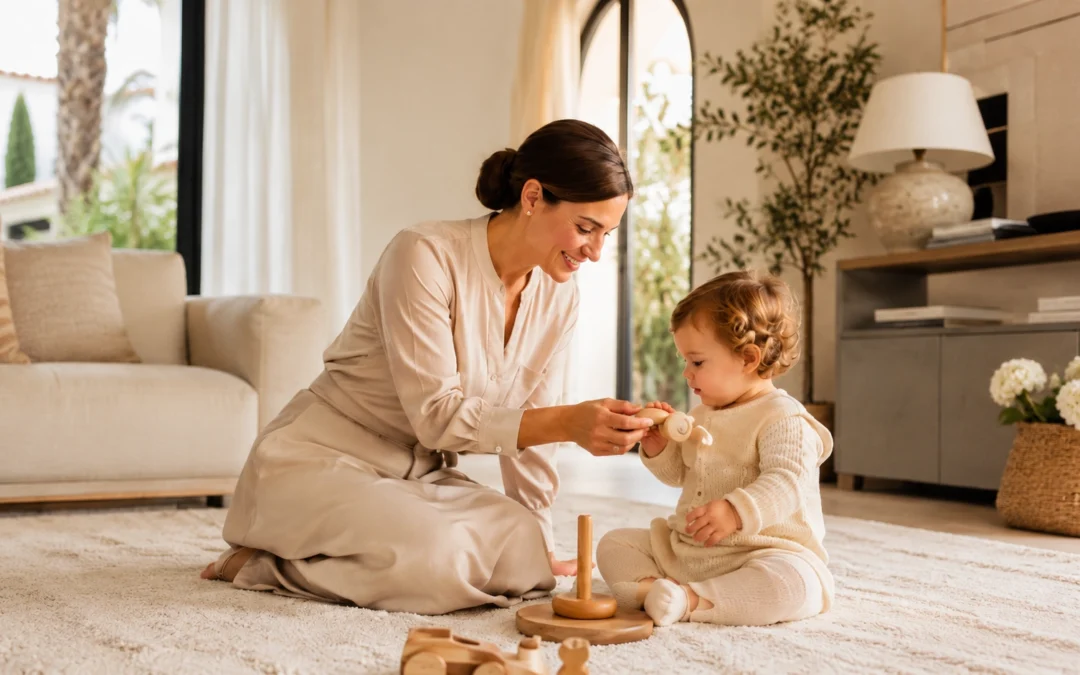
“Live-in nanny vs au pair” is one of the most common mix-ups families make when searching for childcare, and it’s an easy one to make. In practice, the two are generally quite different. An au pair is typically a young person on a cultural exchange, offering light, limited help. A live-in nanny is generally a trained professional with fuller responsibility. For families in Marbella and Madrid, knowing the difference makes choosing the right kind of childcare much easier.
Here’s the thing worth knowing early: when families search for “au pair,” they usually just mean a live-in person, and more often than not, what they’re really picturing is someone who helps with both children and the home. That’s closer to a live-in nanny-housekeeper than a traditional au pair. It’s a mix-up we see constantly. So whether “au pair,” “live-in nanny,” or “combined live-in help” brought you here, this guide is written for you.
Key points:
- An au pair is generally a young person on a cultural exchange, offering a limited number of hours of light childcare in return for board, lodging and pocket money.
- When families search for “au pair,” they usually mean a live-in person, and often, specifically, someone who can help with both children and light housework. That’s generally closer to a nanny-housekeeper.
- A live-in nanny is generally a trained childcare professional, employed on a salary and contract, who typically takes fuller responsibility for your children.
- Both usually live in your home, but that’s broadly where the similarity ends.
- Au pairs typically work fewer hours (commonly around 25 to 30 a week); a nanny generally works full-time and brings qualifications and/or hands-on experience.
- For most families in Marbella and Madrid looking for dependable, professional care, a nanny tends to be the closer fit, though for some households, particularly with older children and lighter needs, someone available for fewer weekly hours may suit well.
One of the most common requests we hear from families in Marbella and Madrid is some version of “we’d love an au pair,” when what they go on to describe is, in practice, closer to a live-in nanny, often, more specifically, a live-in nanny-housekeeper who can help with both children and the home. It’s an understandable mix-up: both typically live in your home, and both help with your children. But a nanny and an au pair are generally two different kinds of arrangement, and choosing the wrong one can leave everyone with mismatched expectations. This guide clears up the confusion in general terms; for anything specific around visas or employment law, it’s always worth checking with a professional.
What an au pair generally is
The word “au pair” comes from the French for “on equal terms,” which captures the general idea. An au pair is typically part of a cultural exchange: a young person, generally aged somewhere between 17/18 and 30 (an upper age limit that tends to apply fairly consistently across au pair schemes), usually from another country, who comes to live with a host family. In return for a room, meals and pocket money (a stipend, not a professional wage), they generally help with light childcare and a few household tasks.
The defining feature is the limits. Au pairs typically work a capped number of hours, commonly around 25 to 30 a week, with time set aside to learn the language and experience the culture (usually considered the real point of the arrangement). An au pair generally isn’t a trained childcare professional, and shouldn’t be expected to take sole charge of a very young baby, or to run long days alone without support. Their role is generally about helping out and sharing in family life, not carrying full professional responsibility.
It’s also worth knowing that Spain generally doesn’t have a dedicated, official “au pair visa” or standalone national programme, unlike some other countries. Au pair stays are typically arranged instead through the broader European cultural-exchange framework, and non-EU au pairs commonly enter on a student-type visa rather than a specific au pair category. Because the rules can depend on nationality and individual circumstances, this is generally worth checking directly with the relevant consulate or an immigration professional, rather than relying on general guidance like this.
What a live-in nanny generally is
A live-in nanny is generally a childcare professional who happens to live in your home. The living arrangement is usually there for convenience and flexibility; the point of the role is professional care, not the living situation itself. A live-in nanny typically brings training and/or hands-on experience, generally takes fuller or sole responsibility for the children, works agreed full-time hours, and is usually employed on a formal contract with a professional salary and Social Security registration.
Many hold relevant qualifications such as paediatric first aid and safeguarding training, along with years of checkable references. Where a household needs more than childcare, a nanny-housekeeper role can generally cover both, while a dedicated nanny typically keeps her focus on the children.
Nanny vs au pair: the key differences
| Au pair | Live-in nanny | |
|---|---|---|
| Main purpose | Cultural exchange and language immersion | Professional childcare |
| Experience | Generally young, often with limited experience | Typically trained and/or experienced |
| Responsibility | Light, supported childcare | Fuller or sole responsibility |
| Hours | Typically limited (commonly around 25–30 per week) | Generally full-time, as agreed |
| Pay | Pocket money plus board and lodging | Professional salary, contract, Social Security |
| Housework | Light, shared tasks | Generally child-related only, unless a nanny-housekeeper |
| Best suited for | Older children; flexible, lighter help with a cultural dimension | Families needing reliable, professional, often full-day care |
Clearing up the common mix-up
Many families use “au pair” as general shorthand for “someone who lives in and helps with the children.” It’s an extremely common search term for exactly that reason, so if that’s what brought you here, you’re in the right place. But an au pair is typically a specific kind of arrangement, with real limits on hours, responsibility and experience. Treating an au pair as though they were a full-time professional nanny generally isn’t fair to them, and may not be the safest fit for your children either.
More specifically, the confusion often comes down to one particular kind of role: a live-in person who helps with both children and light housework. That combined role generally describes a nanny-housekeeper far more closely than an au pair, since it typically involves fuller responsibility and a broader scope than the cultural-exchange arrangement an au pair is meant to be. Spotting which of these roles you’re actually picturing is often the quickest way to find the right fit.
A good starting point is generally to think about what you actually need, rather than which word feels most familiar. If you need someone to take charge of a baby, manage a full day independently, or provide consistent, experienced care over time, that’s typically closer to a live-in nanny. If you have school-age children and want flexible, lighter help with a cultural and language dimension, an au pair may be a good fit.
Where a nanny fits among other childcare professionals
A nanny and an au pair are just two points on a wider spectrum of childcare roles. Depending on your family, the right fit might instead be a governess for education-focused care, a maternity nurse or newborn specialist for the earliest weeks, a rota nanny for round-the-clock cover, a travel nanny for family trips, or a nanny experienced in supporting additional needs. Understanding these roles generally makes the au pair-versus-nanny question easier to answer. If you’re weighing up overall quality too, our guide to what makes a nanny truly exceptional is a useful next read.
Which is right for your family in Marbella or Madrid?
In the international communities of Marbella and Madrid, both arrangements exist. That said, the needs families most often describe to us: English-speaking, professional, reliable, and sometimes able to travel, tend to point towards a nanny rather than an au pair. A few general questions can help make the choice clearer:
- How old are your children, and do they need active, hands-on care, or lighter, after-school support?
- How many hours of care do you genuinely need each week, and how predictable are they generally?
- Do you need professional experience and fuller responsibility, or would helpful, supervised support be enough?
- What’s your budget, bearing in mind that pay generally reflects the very different nature of the two roles?
If a professional nanny sounds like the right fit, our pages on professional childcare in Marbella and professional childcare in Madrid explain how we generally go about matching families with the right candidate. Our guide to finding English-speaking domestic staff in Madrid is also a useful next read for families newer to the capital.
The main takeaway
If there’s one thing to take from this guide, it’s this: when families say “au pair,” what they generally mean is simply a live-in person, and more often than not, what they’re actually describing is a live-in combined role covering both childcare and light housekeeping, much closer to a nanny-housekeeper than a traditional au pair. Spotting that gap early is usually the single most useful step towards finding the right fit, whichever word brought you here.
If you’re weighing up a nanny vs an au pair and would like a clear, honest steer for your family in Marbella or Madrid, get in touch. We’re always happy to help you find the right fit, whichever term brought you here.
Frequently Asked Questions
Is an au pair cheaper than a live-in nanny?
Generally, yes, for a reason. An au pair typically receives pocket money and board as part of a cultural exchange, while a live-in nanny generally earns a professional salary reflecting training, experience and fuller responsibility. Typical nanny figures are set out in our guide to nanny costs.
Can an au pair look after a baby?
As a general rule, an au pair shouldn’t be the sole carer for a very young infant. Caring for a baby usually calls for the experience of a professional nanny, or a maternity nurse for the newborn stage.
Do I need a contract for a live-in nanny?
Generally, yes. A live-in nanny is typically employed on a proper contract with Social Security registration, meant to protect both your family and your nanny. It’s worth checking the specifics of your situation with a professional.
We have room for someone to live in, so which should we choose?
Having the space is a good start, but a spare room alone generally doesn’t cover everything worth thinking through. Sharing a kitchen and living areas, everyone’s privacy, and how well someone’s general lifestyle fits your household tend to matter just as much as the room itself, whichever role you choose. Beyond that, your children’s ages and the level of care you genuinely need are the better guide; the living arrangement usually follows from that.